HAPPY FRIDAY,
Happy Halloween eve. If you're handing out candy tomorrow, I'd suggest not overthinking the strategy, unlike Google, which has spent the last few years carefully optimizing itself into a corner. More on that below.
In This Week's AI Fridays:
- Google's AI Mode isn't making money, and the publishers it hollowed out can't exactly bail it out
- Most marketers say AI is working. Fewer can show the receipts
- ChatGPT ads are here, and they're structurally different enough from Google to warrant actual attention
- AI Mode queries are three times longer than standard search, and your landing pages probably aren't keeping up
- Plus: religious AI exemptions, lawyers keeping their efficiency gains, and Canva editing your designs by looking at them
Google Starved Out Publishers With AI Search. Now, Its Pivot Is Blowing Up in Its Face.
For years, Google's AI Overviews redirected traffic away from the publishers whose content trained its models and filled its index. The implicit bargain was that AI would make Search better and that ad revenue would follow. AI Mode was supposed to be the payoff. It isn't.
The problem is structural. Fewer clicks means fewer ad impressions. The publishers who would have absorbed that traffic and monetized it on their own terms are either gone or in much worse shape than they were three years ago. Google built a system that made itself the destination and is now discovering that being the destination is expensive when the ads don't convert.
The Highlights:
- Google's AI Mode is generating fewer ad clicks than standard Search, with revenue per query running well below expectations
- Publisher traffic losses from AI Overviews have been well documented since 2024; many of the outlets that absorbed overflow search traffic have since scaled back or closed
- Google's Q3 Search revenue growth slowed to 12%, and AI Mode ad revenue is not being reported as a separate line, which makes the actual picture harder to read
- The same zero-click dynamic that hurt publishers is now surfacing inside Google's own economics
The Takeaway:
The strategy that looked like dominance turned out to be eating the seed corn. Google needed a healthy publisher ecosystem more than it realized, and it spent three years finding that out.
Most Marketers Say AI Works. Few Can Prove It.
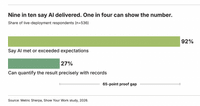
The survey numbers are familiar by now: large majorities of marketers report that AI has improved their work. The less comfortable finding is that most of them set up their AI initiatives without baseline metrics, which means the improvement they're reporting is largely a feeling rather than a measurement. That's not a technology problem, it's a planning problem, and it predates the AI rollout by several steps.
What's worth sitting with here is that speed is genuinely measurable, but teams are often measuring the wrong thing. Content produced faster is not the same as better outcomes produced faster, and if your success metric was always "did we ship more," AI will look like a triumph regardless of what happens downstream.
The Highlights:
- A majority of marketers in the survey say AI has improved their work; a minority can point to data showing it
- The most common gap: no baseline metrics established before AI tools were introduced, making before-and-after comparison impossible
- Speed and volume are the most tracked outputs; conversion quality, customer value, and revenue attribution are tracked far less often
- The problem tends to start at the brief stage, not the tool selection stage
The Takeaway:
If you didn't measure it before, you can't measure the improvement after. The AI is probably helping. You've just made it difficult to tell anyone by how much.
AI in Marketing
ChatGPT Ads vs. Google Search Ads: 5 Differences to Consider in Your Strategy
ChatGPT running ads was always a matter of when, and now that it's here, the question isn't whether to pay attention but how different it actually is from what you already know. The short answer is: different enough to matter. Google Search ads operate on keyword intent, which is a well-understood model after two decades of refinement. ChatGPT ads are appearing inside conversations with longer, more contextual queries, which changes how targeting works, how creative needs to function, and how you'd even begin to attribute a conversion. Measurement is the open question, as the infrastructure is genuinely newer than most of the playbooks being applied to it. Worth experimenting with, probably too early to shift meaningful budget toward, and the five structural differences in this piece are a reasonable place to start if you're briefing a team on it.
AI Mode Queries Are 3x Longer. Your Landing Pages May Not Answer Them.
Google's AI Mode is producing queries that are roughly three times the length of standard search queries, which is a meaningful shift in what users are asking when they arrive at your content. Most landing pages were built for short-tail intent: someone typed three words, they want a fast answer, here is your page. A query that is three times longer is usually more specific, more conditional, and expects a more specific response. If your page was written to intercept "project management software," it may not satisfy someone asking which project management tool works best for a team of ten that already uses Slack and needs approval workflows. The mismatch between how people are now searching and what most landing pages say is underappreciated, and it's worth auditing a few of your higher-traffic pages against the kinds of queries driving them in AI Mode.
OpenAI Slashes Price for Model Again
Another price cut from OpenAI, which at this point is starting to feel like a quarterly tradition. The enterprise economics of AI keep improving, which is genuinely good news, though it tends to surface a different problem: organizations that are now paying less per token still haven't sorted out which model to use for which task. Price is no longer the main barrier for most teams that have budget to spend. The model selection question, which sounds administrative but has real quality implications, is proving harder to resolve than expected. Cheaper access to the wrong model for a given use case is still the wrong model.
AI's Production Push Puts Data Platforms on the Hook for Results
The conversation in enterprise AI is shifting, somewhat noticeably, from what the technology can do in a controlled environment to what it returns when deployed at scale. Data platforms are being asked to demonstrate that they can carry AI pilots through to measurable production outcomes, which is a more demanding standard than most of them were held to during the pilot phase. The dynamic is familiar from earlier technology cycles: the proof of concept gets funded on potential, and then at some point someone asks for the numbers. That moment appears to have arrived for a meaningful portion of enterprise AI programs, and the platforms that have been positioning themselves as infrastructure rather than outcomes are finding that positioning harder to sustain.
Quick Hits
- Google's AI Mode ad revenue is not being broken out separately in earnings reports, which makes it genuinely difficult for advertisers to understand what they're buying into; 12% Search revenue growth in Q3 is the number people are watching. Read more
- A university administrator received a religious exemption from using AI at work, which opens questions about workplace AI mandates that most HR departments are probably not prepared for. Read more
- Enterprises deploying AI agents are finding that role-based access control is the actual constraint, not model quality; the agent can only be as useful as the data it's allowed to see. Read more
- 55% of lawyers in Victoria now use AI, up from 37% last year; client fees have not moved accordingly, which tells you most of what you need to know about where efficiency gains tend to land. Read more
- Proton's CEO publicly positions the company against Big Tech AI while internally pressuring engineers to build with it over their own security objections; the gap between the manifesto and the memo is instructive. Read more
- Canva has launched Brush, a vision-language model that edits designs by looking at them, which is worth knowing if Canva is part of your creative workflow and you haven't checked in on it lately. Read more
This article was obviously generated with AI but curated by a human, don't be weird about it.
Compiled by

Pete Bishop
Chief Innovation Officer, ZGM Modern Marketing Partners
Pete Bishop has spent the last two decades helping brands adopt new technology without losing the plot. He hosts Artificial Breakdown, a podcast and weekly newsletter that translates AI news into practical marketing decisions, and scans 50+ sources each week to write this issue.
Get this in your inbox
One email a week with the AI and marketing news worth your time.